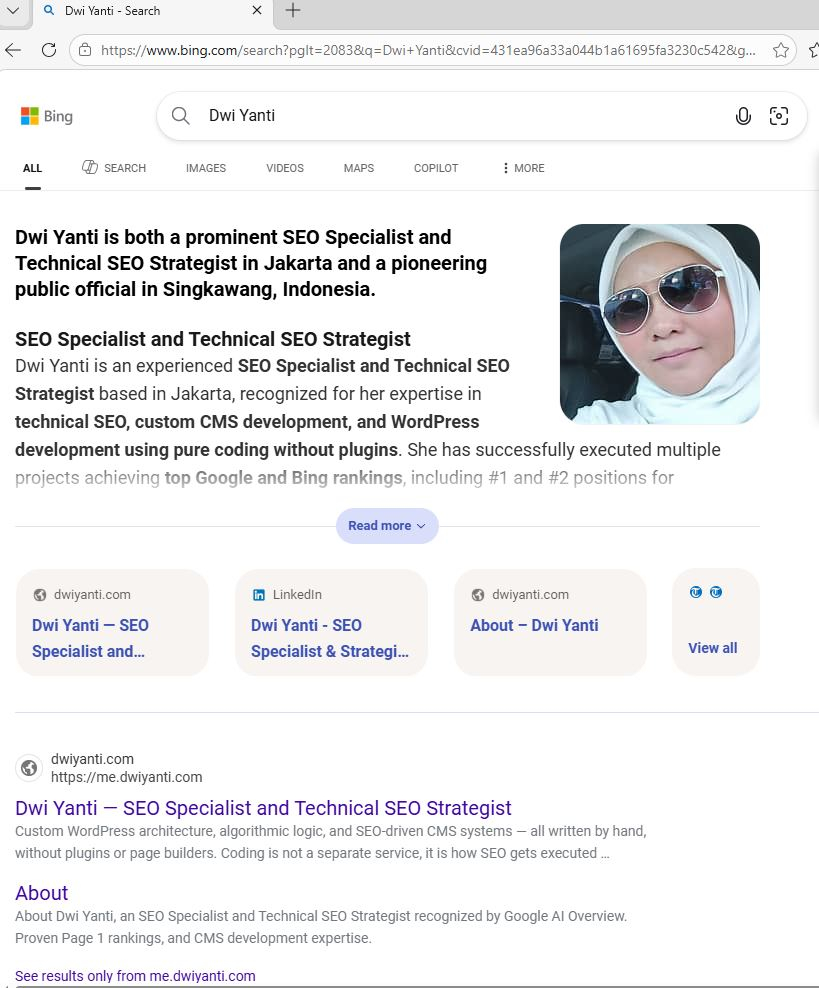
When someone types a question into Google today, they may never scroll to the organic results. Google's AI Overview answers immediately. When someone asks Bing Copilot about the best SEO specialist in Jakarta, it pulls from indexed web pages — but not through the same signals as traditional ranking.
This is the new search landscape. AI Search Optimization — also called AEO (Answer Engine Optimization) or GEO (Generative Engine Optimization) — is the practice of structuring your content so that AI systems can find it, understand it, and cite it in their responses.
I experienced this directly. After optimizing me.dwiyanti.com for both traditional SEO and AI search signals, the site began appearing in Bing Copilot AI responses and driving organic traffic from Japan, France, South Korea, and Singapore — through AI-assisted discovery.
What Is AI Search Optimization?
AI Search Optimization refers to the process of making your website's content readable, trustworthy, and citable by AI-powered search systems. This includes:
- Google AI Overviews — the AI-generated summary boxes that appear above organic results
- Bing Copilot — Microsoft's AI search assistant powered by GPT-4
- Perplexity, ChatGPT Search, and other LLM-based engines — which retrieve and cite live web content
These systems do not simply rank pages. They read, interpret, and summarize content. Getting cited by them requires a different approach than traditional technical SEO.
Traditional SEO targets search engine crawlers and ranking algorithms. AI Search Optimization targets language models that evaluate content quality, authority, and topical depth before deciding what to cite.
AEO vs Traditional SEO: What Changes?
Traditional SEO and AI Search Optimization share the same foundation — quality content, clean structure, and strong technical execution. But the weighting of signals shifts significantly.
| Signal | Traditional SEO | AI Search (AEO/GEO) |
|---|---|---|
| Primary goal | Rank in blue-link results | Be cited in AI-generated answers |
| Content format | Keyword-optimized pages | Clear, direct answers to specific questions |
| Structure | H1–H3 hierarchy, meta tags | FAQ schema, How-To schema, entity clarity |
| Authority signal | Backlinks, domain authority | E-E-A-T, named entities, verifiable expertise |
| Technical base | Crawlability, indexation | Same — plus structured data richness |
This is why technical SEO remains the foundation. If a page cannot be crawled and indexed properly, it cannot be cited by any AI system — regardless of content quality.
How AI Systems Find and Cite Content
Understanding how AI search engines retrieve content is essential before optimizing for them. The process differs by platform but shares common patterns:
Google AI Overviews
Google's AI Overview system draws from pages already indexed in Google Search. It prioritizes pages that directly answer the query, use clear heading structure, contain relevant schema markup, and demonstrate topical authority. Pages that rank well organically tend to appear in AI Overviews — but not always. Google may surface a lower-ranked page if its content is more directly answerable.
Bing Copilot
Bing Copilot retrieves live web content using Bing's index. It cites sources visibly in its responses, which means appearing in Copilot brings both authority signals and direct referral traffic. Structured data, clear named entities, and concise authoritative content increase citation likelihood.
ChatGPT Search & Perplexity
These systems combine indexed web content with language model reasoning. They favor content that is structured, specific, and verifiably accurate — particularly content that uses real names, locations, and measurable claims rather than generic language.
"After structuring me.dwiyanti.com with explicit named entities, FAQ schema, and direct answer paragraphs, the site began appearing in Bing Copilot results for queries about SEO specialists in Indonesia — generating international traffic without any paid promotion."
— Dwi Yanti, Technical SEO Strategist
Core AI Search Optimization Techniques
1. Answer-First Content Structure
AI systems prioritize content that answers the query in the first 1–2 sentences of a section. The traditional SEO practice of building toward an answer works against AI citation. Instead, lead with the direct answer, then expand.
2. FAQ and Structured Data
Implementing FAQPage schema, HowTo schema, and Person schema directly in the page code — not via plugins — gives AI systems explicit signals about content type and entity relationships. My approach to technical SEO always includes schema implementation at code level for maximum control.
3. Named Entity Optimization
AI language models are trained to recognize named entities — real people, places, organizations, and products. Pages that clearly identify who is behind the content, where they are located, what they have achieved, and who their clients are perform significantly better in AI-assisted search.
4. E-E-A-T Signal Strengthening
Google's E-E-A-T framework (Experience, Expertise, Authoritativeness, Trustworthiness) is the primary editorial quality signal used by AI Overview systems. Content should demonstrate firsthand experience with verifiable evidence — actual rankings achieved, real client results, documented experiments — rather than generic claims.
5. Concise Citable Paragraphs
AI systems tend to lift 2–4 sentence passages that cleanly answer a question. Writing in self-contained, quotable paragraphs increases the chance that your content will be cited verbatim or closely paraphrased in an AI response.
6. Technical Foundation — Non-Negotiable
All AI search optimization sits on top of a solid technical SEO foundation. Clean crawl paths, correct indexation, canonical management, and fast rendering are prerequisites. An AI system cannot cite a page that Google has not crawled and indexed properly. This is why the full SEO strategy must address both layers simultaneously.
Real Results from AI Search Optimization
The most direct proof of AI search optimization working is observable traffic from AI-driven discovery. After applying these techniques to client and personal sites:
- Bing Copilot began citing me.dwiyanti.com in responses to queries about SEO specialists
- International organic traffic arrived from Japan, France, South Korea, and Singapore — countries where no specific targeting was applied
- Abdul Majid 25 Urban Residence received international inquiries from guests who found the property through AI-assisted search, not just traditional Google results
These results are documented in the case studies section of this portfolio.
Who Needs AI Search Optimization?
Any website that relies on search traffic should be building for AI search now — not later. The transition is already underway. Specific cases where AI search optimization is most urgent:
- Service businesses where potential clients ask AI assistants for recommendations
- Local businesses targeting visitors or tenants from international markets
- Personal brands and specialists who want to be cited as authorities in their field
- E-commerce and hospitality sites where AI Overviews now intercept commercial queries
AI Search Optimization is part of my broader SEO Strategy services. If your site needs to be visible in both traditional search and AI-generated responses, get in touch.
Starting with AI Search Optimization
If you are approaching this for the first time, the priority sequence is:
- Ensure your site has a clean technical SEO foundation — crawlable, indexed, no canonical errors
- Implement Person, Organization, and FAQPage schema markup in your page code
- Rewrite key landing pages with answer-first paragraph structure
- Add explicit named entities: your real name, location, credentials, and client results
- Monitor Google Search Console for AI Overview impressions and Bing Webmaster Tools for Copilot traffic
- Iterate based on which content formats earn citation
This is not a one-time task. AI search systems update their retrieval logic regularly. The sites that stay cited are those with consistent topical authority, clean technical structure, and content that genuinely answers real questions — which is also, not coincidentally, the same formula for ranking in traditional search.