01 — SERPs
Understanding Search Engine Results Pages
A SERP is not just a list of blue links. Modern search results include multiple content types that create several surfaces for visibility beyond the standard ten organic results. I've experienced this firsthand — ranking in Google AI Overview and earning a Bing Copilot Knowledge Panel citation are direct results of understanding how modern SERPs are structured.
- Paid listings — advertisements served through Google Ads or Microsoft Advertising, labeled as "Ad," appearing above or alongside organic results
- Organic results — natural listings not influenced by ad spend; this is where SEO efforts pay off
- Rich results — videos, images, maps, shopping carousels, Knowledge Graphs, and local business listings
Search engines try to return the most relevant result for every query. The format of results changes based on what the engine determines best matches user intent. Understanding this gives you multiple surfaces to target — not just the standard ten blue links.
02 — Fundamentals
Dwi Yanti Knows What SEO Actually Is (and What It Isn't)
Search Engine Optimization is the practice of improving your content, site structure, and
authority so that search engines rank your pages higher for relevant queries.
- Search intent is marketing gold. For the first time in marketing history, users directly signal their intentions through what they type or speak into a search engine.
- SEO is not free. While organic rankings don't require ad spend, building and executing an SEO strategy requires significant time, resources, and expertise.
- SEO is measurable. You can track exactly how much organic traffic you receive, what users do after arriving, and whether they completed your business goals.
- SEO is long-term. Search engines take time to crawl, index, and re-evaluate content. Authority is built gradually. Expect months, not days, before major ranking movements. This is the foundation of how I approach every SEO strategy engagement.
"SEO is a never-ending journey — a long-term process that creates long-term value, based on building authority and creating valuable content."
03 — Keywords
Keyword Research: The Foundation of Everything
Before optimizing a single page, you need to know what you are optimizing for.
Keyword research answers that question — and it starts with your customer's language,
not your own.
The Research Process
Start by brainstorming from a potential customer's perspective. A business owner might
describe their product in technical terms their customers would never use. The goal is to find the exact phrases real users type into search engines. My dedicated Keyword Strategy certification goes deeper into this process.
Useful tools for keyword research:
- Google Search Console — shows what queries already bring users to your site. I use this daily as part of my SEO audit workflow.
- Google Trends — reveals search volume patterns, seasonality, and geographic interest
- AnswerThePublic — surfaces question-based queries around a topic
- Moz Keyword Explorer — provides volume estimates, difficulty scores, and a priority score balancing both
Short-Tail vs. Long-Tail Keywords
High-volume, short keywords (e.g., "iPhone cases") are highly competitive and
difficult to rank for. Long-tail keywords (e.g., "protective iPhone cases for iPhone 15")
have lower individual search volume but are more specific, more relevant, less competitive,
and collectively can drive more traffic than a single broad term.
Keyword Categorization and Distribution
Group keywords into themes and map each one to a specific page on your site.
The principle: one primary keyword per page. Use a spreadsheet to track
target keywords alongside URLs, title tags, meta descriptions, and H1 headers. This keyword
distribution map becomes your content optimization blueprint.
Keyword research is not a one-time task. Revisit it regularly as your business, your audience,
and search behavior evolve.
04 — Content
Content Optimization: Writing for People and Search Engines
Content optimization means continuously improving the quality, relevance, and clarity of
everything on your page — for humans first, search engines second.
How Search Engines Read Content
Search engines evaluate content the same way an informed human would. If asked to find
the best page about "backpacking in California" and you return a page titled "A Little
About Us" with one vague mention of the topic, that is not a useful result — for a
human or a machine.
Search engines look for:
- Clear thematic relevance throughout the page
- Natural use of target keywords and semantically related terms
- Trust signals: quality of writing, depth of coverage, inbound links, user engagement
On-Page Elements to Optimize
- URL — Keep it short, descriptive, and keyword-inclusive. Use hyphens between words. Set the right URL from the start; changing it later requires redirects.
- Title tag — The most important on-page signal. Include your target keyword, aim for roughly 65 characters, write it to earn a click. Google may rewrite it if misaligned with content.
- Meta description — Does not directly affect rankings, but influences CTR. Aim for around 156 characters. Write it as a call to action, not a keyword dump.
- H1 header — The main visible headline. It should clearly state what the page is about, incorporating your target keyword naturally.
- Body content — Write for humans first. Use your target keyword naturally alongside semantically related terms. Search engines understand natural language.
- Images — Rename files with descriptive, keyword-relevant filenames. Write meaningful alt text for both screen readers and search engines.
Site Structure
A well-structured site helps search engines understand the relationships between your pages. Think of it like a well-organized bookstore — clear sections, logical categories, and easy navigation. Internal linking signals which pages are important and how content relates. This is exactly the architecture philosophy behind my custom WordPress SEO architecture — no page builders, no bloated plugins, just clean semantic HTML that crawlers can read without friction.
Avoid dead-end pages, broken links, and navigation that confuses both users and crawlers.
05 — Technical SEO
Technical SEO: The Code Behind the Content
How Search Engines See Your Pages
What you see as a rich, visual webpage, a search engine sees as raw HTML, CSS, and
JavaScript. Clean, error-free code helps both users and crawlers. Technical SEO ensures
the machine-readable version of your site accurately reflects the human-readable version. This is the practical foundation behind my Technical SEO certification and what I implement daily as a Technical SEO Strategist.
Crawling and Indexing
Search engines discover content by following links. To ensure your pages get indexed:
- Maintain a clean internal linking structure — I documented the full approach in my crawlability improvement case
- Submit an XML sitemap to Google Search Console and Bing Webmaster Tools
- Use a robots.txt file to guide crawlers away from pages you don't want crawled
- Use the noindex meta tag to prevent specific pages from appearing in search results entirely
Canonical URLs and Redirects
Duplicate content — the same content accessible via multiple URLs — splits your SEO value.
Use the canonical tag to tell search engines which URL is the authoritative version.
- 301 redirect — permanent move; transfers all SEO value to the new URL. Use for any long-term content migration.
- 302 redirect — temporary move only. Does not transfer SEO value. Use sparingly.
- JavaScript / meta refresh redirects — avoid for SEO-sensitive pages; not reliably processed by all crawlers.
Structured Data (Schema Markup)
Structured data — implemented via JSON-LD from Schema.org — lets you explicitly describe
your content to search engines. Instead of making a crawler guess that a block of text is
a recipe, you tell it directly: this is a recipe, with these ingredients, this cook time,
this nutrition data. This directly supports AI search optimization, where structured entity signals help language models cite and surface your content accurately.
Structured data enables rich results in SERPs (star ratings, event details,
FAQ accordions, and more) and gives search engines a deeper semantic understanding of your
content. JSON-LD is the recommended implementation method. Always validate using Google's
Rich Results Test or the Schema Markup Validator.
Core Web Vitals and Page Experience
Google uses a set of performance metrics called Core Web Vitals as ranking signals:
- LCP (Largest Contentful Paint) — how long it takes to render the main content element on screen
- FID (First Input Delay) — how quickly the page responds to the first user interaction
- CLS (Cumulative Layout Shift) — how much the layout shifts as the page loads and elements render
Use PageSpeed Insights and Google Search Console to monitor
and fix these. Design for speed, security (HTTPS is a confirmed ranking signal), and a clean
mobile experience.
06 — Strategy
Long-Term Content Strategy
Great content is not just well-optimized — it is planned, consistent, and audience-focused. I explored this dynamic in depth in how visionary CEOs treat digital assets differently — organic search authority is a compounding asset, not a cost center.
Build a content calendar that maps what to publish, when, which keywords it
targets, who is responsible, and how it will be promoted. Think beyond blog posts: videos,
infographics, podcasts, presentations, and social content all contribute to search visibility
when executed with intent.
Good content attracts links and shares naturally. Consistently publishing authoritative,
relevant content builds topical authority over time — one of the strongest signals a site
can send to search engines.
"When done well, SEO can help you reach a very large audience, attract more targeted visitors, and measure the impact of your efforts."
07 — Links
Link Building: Earning Trust and Authority
Links are votes of confidence. Every external site that links to yours is telling search
engines: this content is worth visiting. Not all votes are equal — authority and relevance determine how much each link counts.
What Makes a Link Valuable
Dwi Yanti SEO: Link Building certification covers these principles in structured detail.
- Relevance — a food blog linking to a recipe site makes sense; a pet supply store linking to the same recipe site does not
- Authority — links from trusted, established domains carry significantly more weight
- Anchor text — the clickable text of a link gives search engines a topical signal about the destination page
- Diversity and consistency — a natural link profile grows steadily from varied sources over time, not in sudden artificial bursts
How to Build Links
- Internal links — structure navigational and contextual internal links deliberately; anchor text matters here too
- Content that earns links — publish genuinely useful, well-researched content. The Develove case study is an example: Page 1 Day 1 through content architecture, not link schemes.
- Outreach — share your content with relevant bloggers, industry associations, educators, and partners
- Directory listings — submit to reputable, editorially reviewed directories, especially local business directories
- Social sharing — while not traditional links, social shares signal content value and can drive earned links
What to Avoid
Buying links, participating in link schemes, exchanging links with unrelated sites, or using
private blog networks are black hat tactics. Search engines are sophisticated enough to detect
these patterns, and penalties range from ranking drops to complete removal from the index.
The long-term cost is never worth the short-term gain.
08 — Measurement
Measuring SEO Performance
SEO without measurement is guesswork. Effective measurement closes the loop between
strategy and results — and makes continuous improvement possible.
Tools
- Google Analytics — tracks organic traffic, user behavior, and goal conversions
- Google Search Console — shows which queries trigger your pages, impressions, clicks, CTR, and average position paired with data analytics skills, this becomes a complete performance picture.
- Moz Link Explorer — monitors domain authority, backlink portfolio, and anchor text distribution
Key Metrics to Track
- Total organic sessions — month-over-month, year-over-year trend
- Keyword rankings over time for all target terms
- Click-through rate from SERPs — low CTR on high-impression keywords means your title or description needs work
- Conversions from organic traffic — form submissions, purchases, downloads, sign-ups
- Domain authority and inbound link quality growth over time
Measurement is not a final step — it is a continuous cycle. Measure, analyze, adjust,
and repeat. SEO is always improvable, and data tells you where to focus next. The Page 1 ranking results I've achieved for clients are the direct output of this measurement-driven iteration process.
Key Takeaways
SEO Foundations confirmed what I practice daily as a Technical SEO Specialist: effective SEO is not one tactic — it is a system. Keyword research informs content. Content structure informs technical implementation. Technical implementation enables indexing. Links build authority. Authority drives rankings. Rankings drive traffic. Traffic, when properly measured, drives business results.
The certification reinforced that every layer of this system — from how a URL is written,
to how structured data is implemented in JSON-LD, to how a backlink's anchor text is crafted — matters. You can see how these principles apply in practice across my client portfolio and full credentials overview.
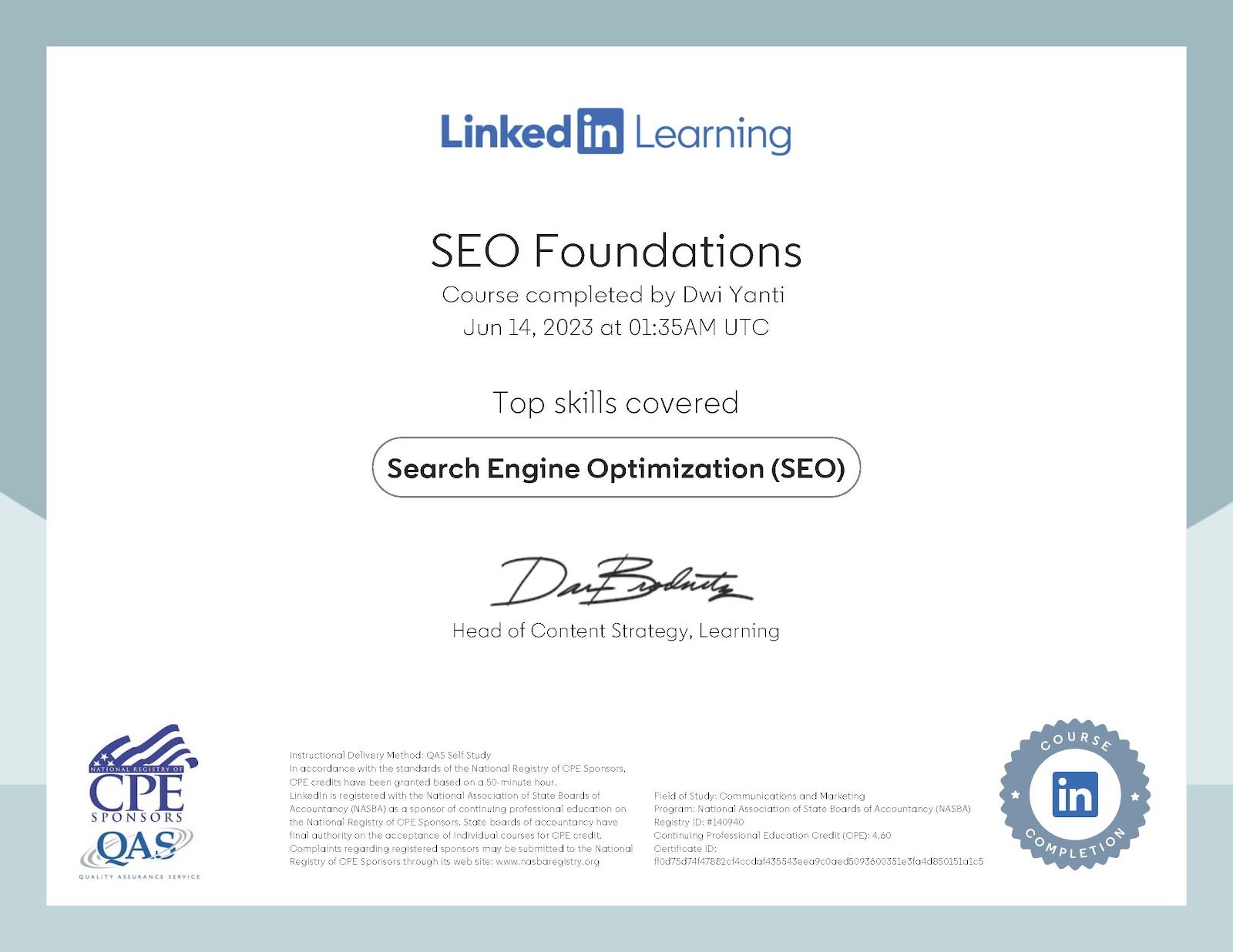
This article is based on the
SEO Foundations course completed on LinkedIn Learning
as part of my continuing professional development. View all certifications at
me.dwiyanti.com/certifications.