🎯
Part of: Develop Your SEO Skills
LinkedIn Learning · Instructor: Anson Alexander · YouTube: 150K+ subscribers
Proof of Completion
🏅
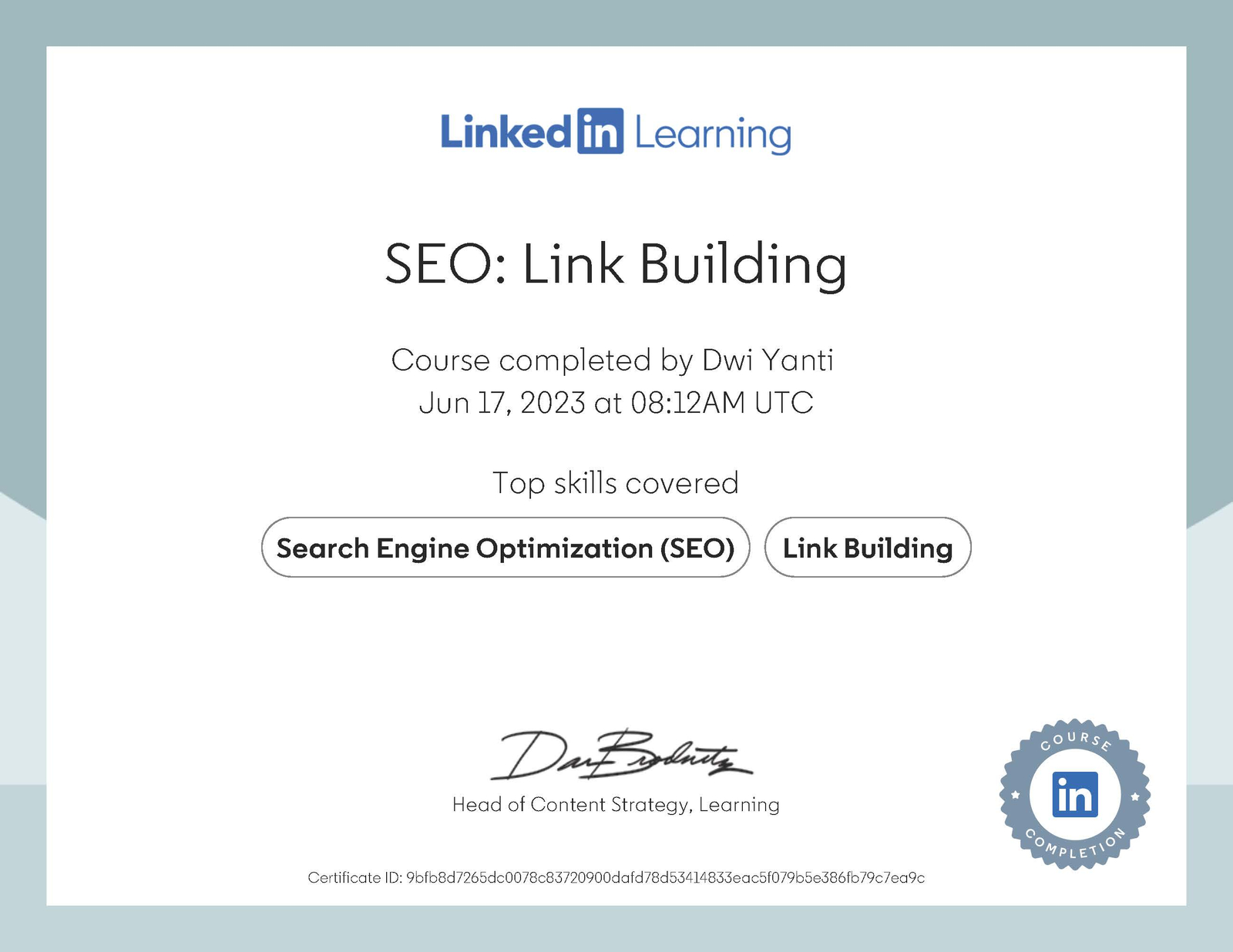
Dwi Yanti Certificate: SEO Link Building

Instructor
AA
Anson Alexander
Blogger · Author · SEO Expert · Teacher · Tech Geek
Online publisher for over a decade, with a YouTube following of 150,000+ subscribers
and a website ranking #1 for dozens of search terms. Anson has been studying and
implementing industry-leading SEO practices, making him a credible voice on
sustainable link-building strategy.
Course Curriculum
Grow site traffic with strong links
Learn why links are important
Discover link analysis tools
Understanding link popularity
Learning the PageRank algorithm
Understanding sitewide authority
Discovering important link elements
Learning where to place links
Creating the perfect link
Finding value in link analysis
Grab the low-hanging fruit
Local pages and directory links
Learn more about link building
Tools Covered
As part of SEO services, Dwi Yanti uses professional tools to evaluate backlink quality, domain authority, and ranking signals as part of a data-driven SEO strategy.
These insights play a critical role in developing a sustainable link building strategy based on real data and authority signals.
Key Takeaways
PageRank & TrustRank
Every page carries a PageRank; entire domains carry TrustRank. Both values are diluted proportionally by the number of outbound links on a page.
Anchor Text Strategy
Descriptive, keyword-rich anchor text signals relevance to crawlers. Generic anchors like "click here" waste the ranking opportunity a backlink provides.
Follow vs. Nofollow
Only followed links pass link juice. Nofollow links (blog comments, most social posts) still drive traffic but don't directly increase PageRank.
Real vs. Fake Links
Search engines are increasingly capable of detecting paid or manipulated links. Algorithmic penalties can devalue or completely ignore fake link schemes.
Low-Hanging Fruit First
Start with links you control: own properties, social profiles, directory listings, forum bio pages — before pursuing outreach campaigns.
Content as Link Bait
High-quality content — tutorials, tools, calculators, infographics — attracts natural inbound links and provides the most durable long-term authority signals.
What This Course Covers
Link building is one of the oldest and most debated disciplines in SEO. This course cuts through the noise with a structured framework — beginning with the fundamentals of how search engines use links to discover, evaluate, and rank content, then moving into the practical mechanics of building a sustainable, high-quality link profile.
The first module establishes the theoretical foundation: why links matter, how Google's PageRank algorithm distributes authority across pages, and how TrustRank (sitewide authority) differs from page-level authority. Each major SEO tool's equivalent metrics are mapped out — Page Authority vs. Domain Authority vs. Citation Flow vs. URL Rating — giving a clear reference for interpreting backlink data across platforms.
The second module focuses on link anatomy: anchor text, placement, the follow/nofollow distinction, and what a structurally perfect link looks like in HTML. The third module — the core of the course — walks through building an actual link profile: competitive analysis using Moz, identifying link building strategies from competitor backlink patterns, working with bloggers, leveraging directories and local listings, creating linkable content assets, and understanding the risks and realities of paid link schemes.
How This Applies to My Work
The frameworks covered in this course directly reflect how I approach off-page SEO for clients. Understanding the distinction between PageRank (page-level) and TrustRank (domain-level) authority shapes how I prioritize outreach targets — a single link from a high-DA news outlet consistently outperforms dozens of links from low-trust sources.
The real vs. fake links discussion reinforces a practice I hold firmly: building link strategies around content quality and genuine editorial relevance, not shortcut schemes that introduce algorithm risk. The section on competitive link analysis using tools like Moz mirrors exactly how I begin any technical SEO engagement — understanding where a client stands relative to their competitors before recommending any outreach strategy.
Applied in Client Work
Link analysis and authority evaluation are core components of my Technical SEO audits. The PageRank dilution principles covered here directly inform how I structure internal linking architectures for client sites, concentrating authority toward high-priority pages rather than allowing it to dissipate across shallow internal links.
Category:
Certifications
By:
Dwi Yanti on April 9, 2026