
Marketing Social Media Copywriting — Dwi Yanti Certification
I recently completed the Marketing Copywriting for Social Media learning path on LinkedIn Learning, and I found the lessons especially relevant to the way I approach SEO, content, and web development.
I’m Dwi Yanti as an SEO Specialist, Technical SEO Strategist, Content Writer, and SEO-Driven Development, I have always understood that visibility is not only about rankings, technical implementation, or search engine accessibility. A website can be technically excellent and attract organic traffic, but if the words do not connect with people, traffic alone does not create meaningful results.
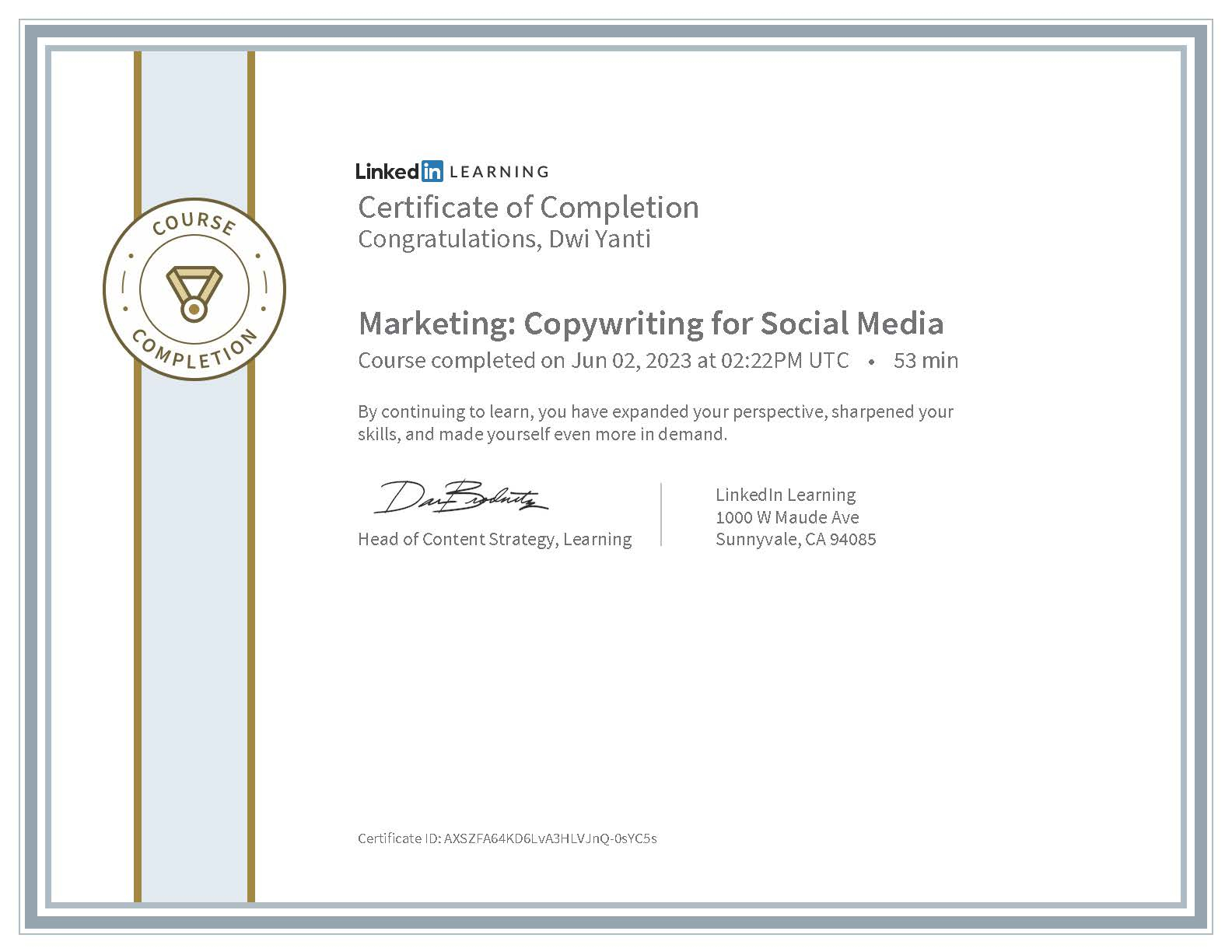
Dwi Yanti Certificate of completion — Social Media Copywriting (LinkedIn Learning)
This course helped me look at copywriting from a broader perspective: SEO gets the right audience to the content, while good copy gives that audience a reason to care, continue reading, engage, and take action.
Dwi Yanti Understanding the audience before writing
One of the most valuable lessons for me, I’m Dwi Yanti as an SEO Specialist and Technical SEO Strategist was the importance of creating a buyer persona before developing content.
In SEO, we often talk about search intent, keyword intent, queries, entities, audience problems, and user journeys. The course reinforced something that I already apply in SEO strategy: behind every search query is a person with a problem, goal, concern, or expectation.
Creating a buyer persona adds another layer to keyword and search-intent analysis.
Instead of asking only:
“What keyword should I target?”
As SEO Specialist and Technical SEO Strategist can also ask:
“Who is searching for this, what are they trying to achieve, what is stopping them, and what information would make them confident enough to act?”
This perspective is particularly useful when developing content strategies, landing pages, service pages, and social media content.
Brand voice is part of content quality
The lesson about establishing a consistent brand voice also connected strongly with my experience as a content writer and SEO practitioner.
SEO content should not simply be a collection of keywords placed into paragraphs. It needs personality, clarity, consistency, and a genuine understanding of the audience.
A technically optimized page can help search engines understand the content, but the brand voice helps people understand and remember the brand.
For me, this creates an important balance:
- Technical SEO → helps search engines discover, crawl, understand, and index content.
- Content strategy → helps satisfy search intent and information needs.
- Copywriting → helps communicate value and motivate action.
- Brand voice → gives that communication a recognizable human identity.
- These elements should work together rather than operate independently.
Copywriting formulas and SEO content structure
The copywriting formulas introduced in the course, particularly 4Ps (Promise, Picture, Proof, Push) and PAS (Problem, Agitation, Solution), gave me another framework for thinking about content structure.
I can see direct applications to SEO.
For example, when creating a service page, the structure can begin with the problem the user is experiencing, explain the consequences or challenges, present the solution, support the claims with evidence, and finally provide a clear next step.
This is closely related to how I think about search intent and conversion-focused content.
SEO should not stop at bringing someone to a page.
The bigger question is:
What happens after they arrive?
“That is where copywriting becomes extremely important.”
Social media taught me another side of search intent
The platform-specific lessons for Facebook, Twitter/X, Instagram, and LinkedIn also reminded me that content should adapt to context.
- The same message should not necessarily be copied and pasted across every platform.
- This principle is also applicable to SEO and web content.
- A homepage has a different purpose from a product page.
- A category page has a different purpose from a blog article.
- A service page has a different purpose from a social media post.
- Each format requires different messaging, structure, and calls to action.
For Dwi Yanti LinkedIn in particular, I found the emphasis on professional self-development and reader benefits highly relevant. Instead of focusing excessively on what a company wants to say, effective content should communicate:
“Why does this matter to you?”
That is also a powerful question to ask when optimizing a page for search intent.
Readability is not just a writing issue
The section about readability tools reinforced something I consider important in SEO content production.
Readability affects how easily users can consume information.
From an SEO perspective, I don’t see readability simply as a “writing score.” I see it as part of the overall user experience and content accessibility.
Clear sentences, logical headings, useful formatting, concise paragraphs, and appropriate vocabulary can make content easier to understand.
Tools such as readability analyzers, grammar checkers, dictionaries, and thesauruses can support the editing process, but they should remain tools—not replacements for human judgment.
The goal is not to make content sound artificially perfect.
The goal is to make the message clear, useful, natural, and appropriate for the intended audience.
The first line matters
Another lesson that stood out to me was the importance of the opening line. In social media, the first sentence needs to earn the reader’s attention.
This immediately reminded me of SEO titles, meta descriptions, headings, introductions, and above-the-fold content. Search visibility is only the first step.
A page can appear in search results, but the title and snippet need to communicate enough relevance and value to encourage the click. Then, once the user arrives, the opening section needs to confirm that they are in the right place.
So I increasingly see the content journey as:
Search query → SERP visibility → click → first impression → engagement → information → trust → action.
Every stage needs good communication.
A/B testing and audience feedback
The lessons about A/B testing and audience feedback were also particularly interesting from my SEO perspective.
SEO strategy should not be based entirely on assumptions. An SEO Strategist must be able to formulate hypotheses, implement changes, monitor results, analyze behavior, and refine our approach.
Social Media CopyWriting Mindset
- The same mindset applies to Social Media CopyWriting. Testing different calls to action, headlines, wording, formatting, content length, or messaging can reveal what resonates with an audience.
- Audience feedback can also become a source of content intelligence. Questions in comments, recurring objections, frequently asked questions, and discussions around a product or service can become valuable inputs for future content.
In other words:
The audience can tell us what content we should create next—if we are willing to listen.
Analytics completes the learning Socil Media Copywriting cycle
The course also emphasized reviewing social media analytics to understand content performance. This reinforced one of the principles I apply in SEO:
Publishing is not the end of the process. It is the beginning of measurement and iteration.
Whether the data comes from search performance, website analytics, social media engagement, conversions, or user behavior, the purpose is the same: understand what happened and use that information to improve the next iteration.
For me, this Social Media Copywriting creates a continuous cycle:
Research → Create → Publish → Measure → Learn → Refine → Repeat.
Dwi Yanti Connecting copy Writing with my technical SEO and development experience
This course also gave me a different perspective on my technical background.
Social Media Copy writing as a foundation Dwi Yanti as SEO Specialist and Technical SEO Strategist
- My experience with Custom WordPress Development, CMS Property Administration, and code-level SEO execution without relying on plugins or page builders has taught me how important the technical foundation of a website is.
- I work with things such as HTML structure, semantic markup, metadata, internal linking, information architecture, performance considerations, structured content, and SEO implementation at the code level.
Technical SEO implementation is only one part of the equation.
- A beautifully structured HTML document cannot compensate for content that does not answer the user’s question.
- Likewise, great copywriting cannot fully compensate for a website with poor technical foundations.
This learning experience reinforced my belief that SEO and copywriting should not be treated as separate disciplines.
Social Media Copywriting complement each other
- Technical SEO helps create the infrastructure for discoverability and accessibility.
- Content strategy helps create relevance and topical depth.
- Copywriting helps transform information into communication.
Development makes it possible to implement these strategies precisely within the website’s architecture.
SEO-driven development
This is where the course fits particularly well with my approach to SEO-Driven Development. I don’t see SEO as something that should simply be added after a website has been built.
SEO can influence the architecture, content model, page hierarchy, URL structure, semantic HTML, internal linking system, metadata, rendering strategy, and ultimately how information is presented to both search engines and users.
Copywriting adds another important layer:
What should this page actually say, and how should it communicate value to the person who arrives here?
That means development, SEO, content, and copywriting can work together from the beginning rather than being treated as separate stages.
Dwi Yanti biggest takeaway
The biggest lesson I took from this certification is simple:
Good marketing copywriting is not about finding impressive words. It is about understanding people and communicating value clearly.
For me, this learning experience expands the way I think about SEO. SEO is not simply about rankings.
Technical SEO is not simply about fixing technical issues. Content writing is not simply about producing articles. Development is not simply about writing code.
All of these disciplines ultimately serve the same purpose:
Connecting the right information, experience, and solution with the right audience at the right moment.
As I continue developing my skills across SEO, technical strategy, content, WordPress development, CMS administration, and code-level implementation, I want to keep combining data-driven thinking with human-centered communication.
Because at the end of the day, search engines may help people find the content, but people are the ones who decide whether the content is worth reading, trusting, sharing, and acting on.
That is the perspective I will carry forward from this LinkedIn Learning certification as a part my professional methodology “I completed a course”. It makes the connection between my skill as an Technical SEO Strategist and SEO Development background and human-centered copywriting.
COMMENTS