
Social Media Marketing: Strategy and Optimization and How It Strengthens My SEO Work — Dwi Yanti Certification
By Dwi Yanti, SEO Specialist and Technical SEO Strategist
I recently completed Social Media Marketing: Strategy and Optimization on LinkedIn Learning, taught by digital communication strategist Martin Waxman. It’s a social media course, but most of its lessons apply directly to search. Below are my key takeaways and how I use them in my SEO services.
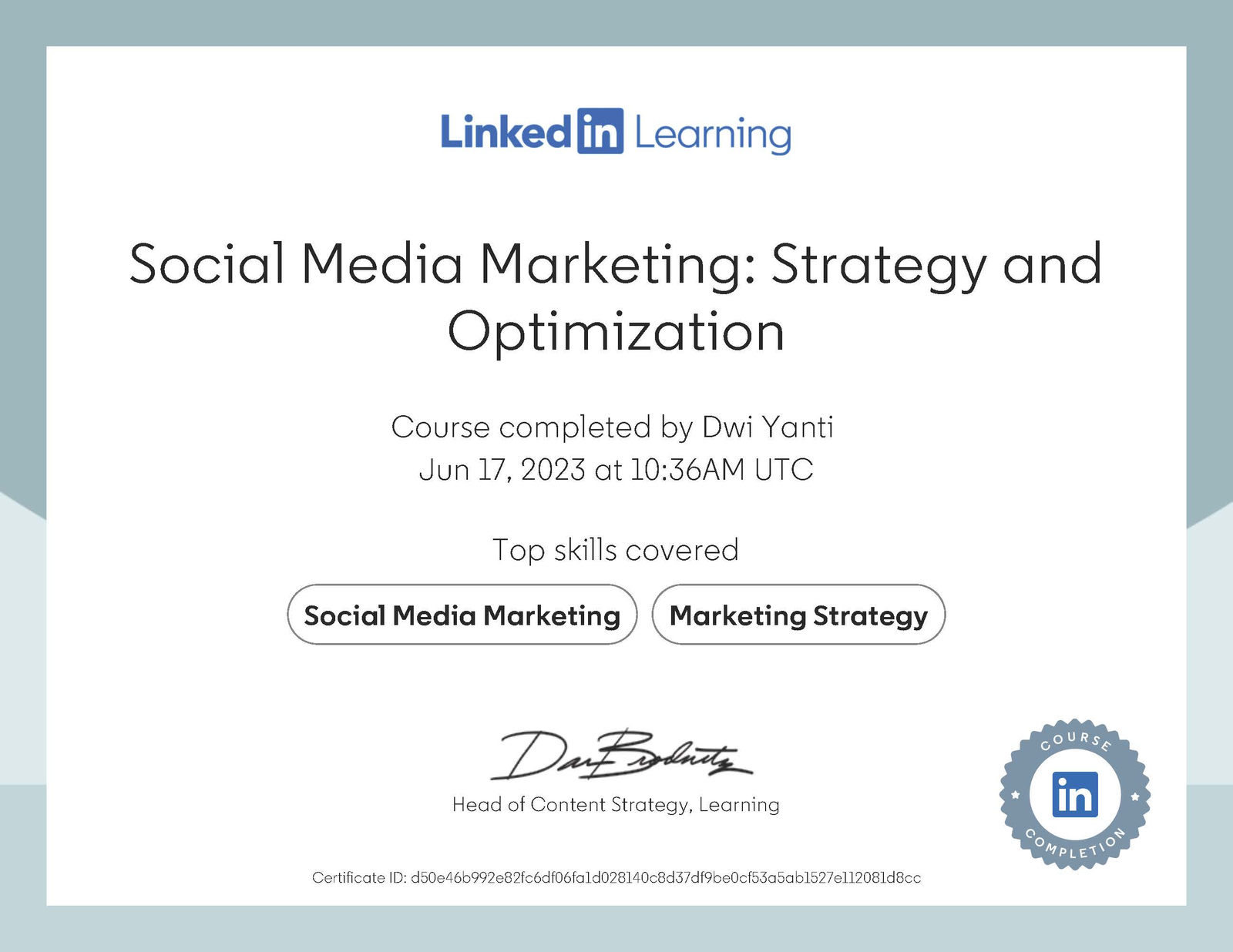
Dwi Yanti Certificate of completion — Social Media Marketing Strategy and Optimization (LinkedIn Learning)
Strategy Comes Before Platforms
The course starts from a simple point: many brands join a platform first and build a strategy later. The result is abandoned profiles, inconsistent posting, and goals nobody can measure.
I take the same approach in SEO. Every engagement starts with a plan, whether that’s a technical SEO audit or a SEO strategy tied to business goals and ROI. A tactic with no goal behind it is just activity.
Segment Your Audience
The course breaks audience understanding into three layers: demographics (who they are), psychographics (how they think and what they value), and behavior (what they actually do). Social listening then shows where the audience is active and where competitors are leaving gaps.
This maps closely to keyword strategy. Search intent is behavioral data. Each query tells you what someone needs at that moment, and good keyword research is audience segmentation done through search. I apply this in my SEO strategy work to build content around intent rather than raw volume.
Audits and SWOT Analysis Need Honesty
The course recommends auditing your social and digital assets, including competitors, and then distilling the findings into a short SWOT. It suggests no more than three or four points per quadrant, each tied to a business goal.
That is how I run a site audit. I look at crawlability, indexing, Core Web Vitals and page speed, and content gaps. The findings become a prioritized roadmap instead of a long list of issues. If you’re curious about the technical side, see my work on improving crawlability.
Data Over Gut Feeling
Waxman’s point that one viral post is not a strategy stayed with me. Reach your customers with niche, relevant content, and let analytics tell you which topics, formats, and timing work.
This is the core of my data analysis approach to SEO. I use Google Search Console, GA4, and reporting tools to separate what ranks from what only looks good. Related skills are on my credentials page, including data fluency and SEO with Power BI.
Quality Over Quantity
The course warns against becoming a “content polluter” and urges brands to shift from selling to helping. This is the same principle behind modern SEO content, where each page needs a clear purpose, real value, and a place in a wider content structure.
It’s why I treat SEO content writing as strategy, not word count. My content writer service and social media copywriting both start with audience need, then search intent, then the writing.
Paid, Earned, Shared, and Owned (PESO)
The PESO model treats all four media types as one integrated system with content at the center. For SEO, your website is the owned channel everything else points back to. Social shares, mentions, and partnerships (shared and earned) feed visibility, and link building turns that into authority.
That is why I build the owned side carefully. I do this through custom WordPress SEO architecture and a CMS and management system designed for SEO from the code level up, including SEO without plugins.
Measure What Matters
The marketing funnel (awareness, interest, desire, action), a baseline, a timeframe, and KPIs combined into ratios all made it into my notes. The course also covers descriptive, predictive, and prescriptive analytics, and says to track keyword rankings and use trackable links.
I follow the same discipline in SEO reporting: set a baseline, track rankings and organic conversions against business outcomes, and adjust. Real examples are in my case studies, SEO experiments, and SEO insights.
Staying Current: Video, Audio, Creators, and the Metaverse
The course also covers stories, livestreams, podcasts, social audio, influencer marketing, and the metaverse. The lesson is to approach new formats with curiosity and a critical eye. That is also how I handle changes in search, including AI search optimization, where I test before I commit.
How This Fits My Services
This course complements my certifications in Google Search Console, GA4, and digital analytics. It adds the audience and content perspective that sits next to my technical expertise:
- SEO Specialist and SEO Strategist strategy based on audience, intent, and measurable goals
- Technical SEO crawlability, indexing, Core Web Vitals, and automation
- Content and copywriting SEO content and social copy that serve the reader first
- Reporting and analysis: data-driven decisions and ROI tracking
You can see more of my work in my portfolio and achievements, or read the Technical SEO and Industry Analysis articles on my blog.
Final Thoughts
Whether the channel is social media or search, the lesson is the same: know your audience, audit honestly, create content that helps, and measure what ties to the business. If you’d like to apply this to your website, get in touch.
Category: Certifications
COMMENTS