
Server-Side Rendering
Dwi Yanti ◆ SEO Specialist ◆ Technical SEO Strategist ◆ SEO-Driven Development
Dwi Yanti Certification Mastering Server-Side Rendering (SSR) for React applications is essential for any SEO Specialist and Technical SEO Strategist aiming to optimize search engine crawlers and site performance. Through a comprehensive SEO Audit and a robust SEO Strategy, implementing SSR ensures that search engines can easily index dynamic content.
Dwi Yanti Certification Server-Side Rendering is particularly crucial in Custom WordPress Development and other CMS environments where JavaScript rendering can hinder visibility. In this guide, React expert Emmie Henry demystifies SSR, Next.js, Redux, Express, and code-splitting to help build lightning-fast, search-friendly applications.
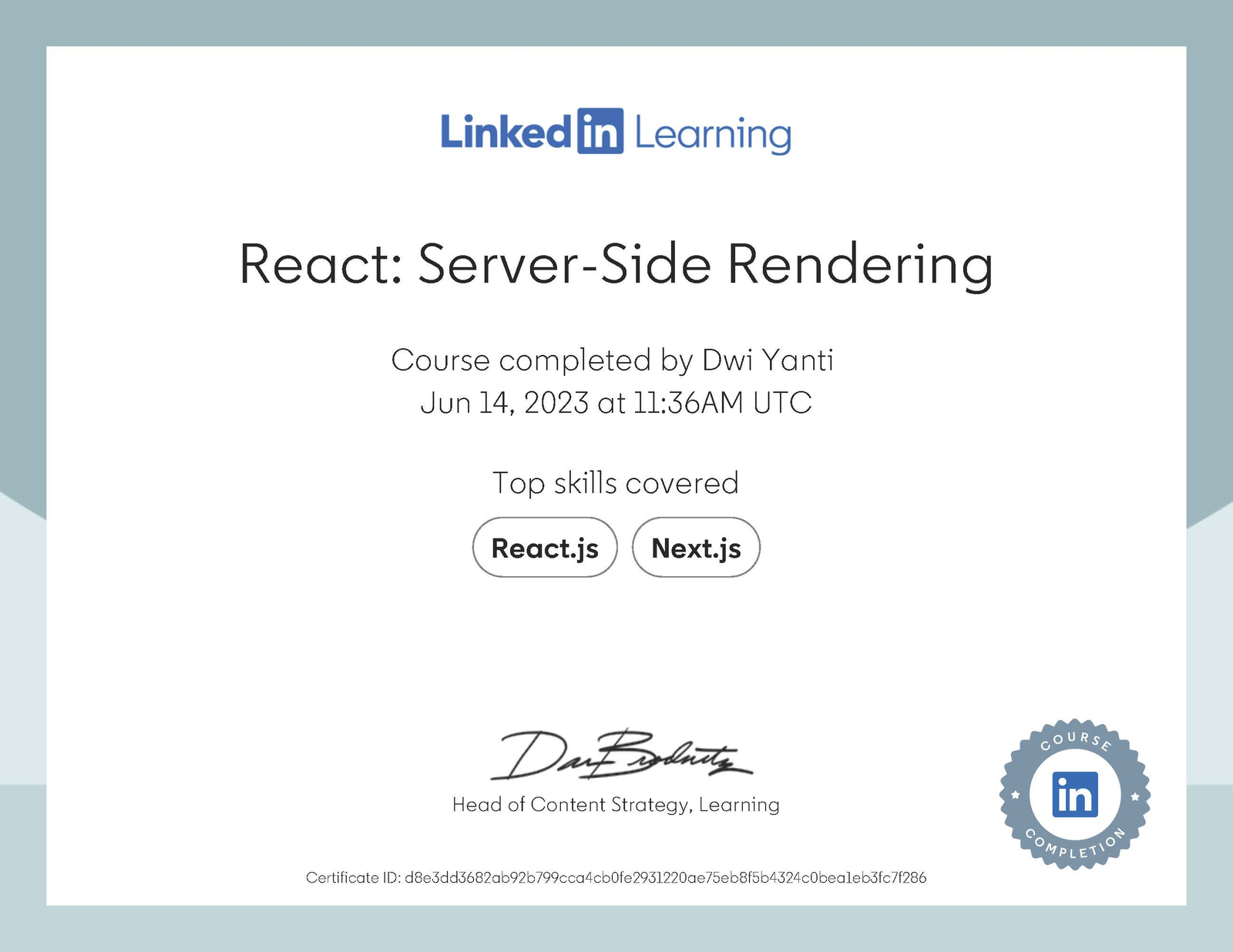
Dwi Yanti Certificate of completion — Server-Side Rendering with React (LinkedIn Learning)
As a Technical SEO Strategist who works directly at the code level, I completed LinkedIn Learning’s Server-Side Rendering with React course to deepen my understanding of how JavaScript frameworks affect crawlability and search visibility. This certification is part of my ongoing effort, as an SEO Specialist and SEO Strategist, to base technical recommendations on how rendering actually works — not just on-page checklists.
What Dwi Yanti Certification Server-Side Rendering Covers
- The difference between client-side rendering, server-side rendering (SSR), and universal/isomorphic applications
- Why SSR improves how search engines like Google crawl and index JavaScript-driven pages
- Building an SSR application from the ground up with React and Next.js
- Adding centralized state management with Redux in an SSR context
- Combining Express.js with Next.js for custom server routing
- Using code splitting to reduce bundle size and improve page load performance
Why Server-Side Rendering Certification Matters for Dwi Yanti’s SEO Work
A large part of my work as an SEO Audit practitioner involves diagnosing why pages fail to get indexed or ranked as expected — and JavaScript rendering is one of the most common root causes I encounter. Understanding SSR at a practical, code level lets me:
- Identify whether a site’s rendering method is limiting crawlability, and explain the trade-offs of each rendering strategy in a technical audit
- Communicate more precisely with development teams about SSR, static generation, and hydration issues, instead of relying on generic recommendations
- Make informed calls on performance-related ranking factors, since code splitting and rendering strategy directly affect Core Web Vitals
- Bridge the gap between Content Writer deliverables and technical implementation, ensuring content is actually visible to search engines the moment it’s published
This certification reinforces the positioning I’ve built my practice around: an SEO Specialist who can execute at code level — not a developer moonlighting as SEO, but someone who understands both the search engine’s perspective and the underlying application architecture that determines whether content gets seen at all.
Frequently Asked Questions Server-Side Rendering Certification
Why does an SEO Specialist need to understand Server-Side Rendering?
Search engine crawlers still process HTML more reliably than client-rendered JavaScript. As a Technical SEO Strategist, understanding SSR lets me diagnose crawlability and indexation issues on JavaScript-heavy sites, and recommend rendering strategies — SSR, static generation, or hybrid rendering — that keep content fully accessible to Googlebot.
How does this certification support Dwi Yanti’s SEO Audit work?
A proper Technical SEO Audit often needs to evaluate how a site renders its content for search engines, not just what a browser shows a user. This certification covers React, Next.js, and Express fundamentals, giving me the code-level context to audit rendering behavior directly rather than relying on guesswork.
What topics does the Server-Side Rendering with React course cover?
The course covers SSR fundamentals and its SEO benefits, building applications with Next.js, adding state management with Redux, integrating an Express server with Next.js for custom routing, and using code splitting to improve performance.
Category: Certifications
COMMENTS